
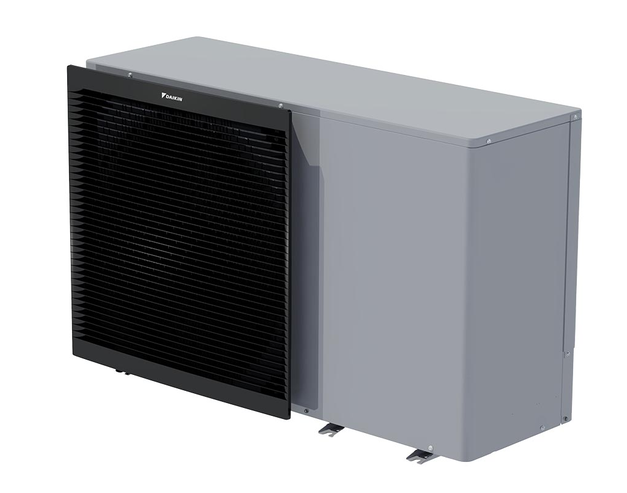
Daikin Altherma 3 9 kW Heat Pump System Architecture
Table of Contents
The Daikin Altherma 3 9 kW heat pump (model EBLA09D3V3U) relies on a hermetically sealed R-32 monobloc architecture that retains all refrigerant circuits within the outdoor casing. This eliminates on-site F-gas handling during a standard air to water heat pump installation, requiring only primary hydraulic connections to be run through the building fabric.
Physical dimensions sit at 870 mm (H) × 1380 mm (W) × 460 mm (D) with a dry weight of 149 kg, demanding adequate ground plinth preparation and mechanical lifting gear on site.
Daikin re-engineered this 3rd-generation chassis around a single oversized fan pushing 48.0 m³/min, moving away from legacy twin-fan configurations. The expanded blade surface area yields lower rotational velocities for the equivalent volumetric throughput, suppressing air-shear turbulence and mechanical vibration without restricting airflow across the outdoor evaporator coil.
Thermodynamic Performance & SCOP Metrics
The Daikin 9 kW heat pump delivers class-leading seasonal efficiency across varying flow regimes, achieving an SCOP of 4.82 at low-temperature design and maintaining 3.44 at medium-temperature outputs, with complete operational stability down to -25°C ambient air temperatures.
- Low-Temperature Applications (35°C LWT): Delivers an SCOP of 4.82 (A+++ ERP rating), making it optimal for modern underfloor heating manifolds and low-temperature emitter layouts.
- Medium-Temperature Retrofits (55°C LWT): Achieves an SCOP of 3.44 (A++ ERP rating), allowing direct integration with existing steel panel radiators without catastrophic seasonal efficiency penalties, provided you verify heat loss calculations and flow temperatures per room.
- Flow & Ambient Envelopes: Sustains a maximum LWT of 60°C at -7°C ambient, utilising R-32’s thermodynamic properties to prevent early engagement of direct-electric elements during peak UK sub-zero design conditions. Full cycle operation continues down to -25°C.
Electrical Demand and DNO Compliance
The Daikin EBLA09D3V3U operates on a standard 230V single-phase (50 Hz) supply. It integrates an internal 3 kW step-1 immersion heater, providing supplementary lift during sub-zero defrost cycles and emergency freeze protection.
Inverter Compressor Draw + 3 kW Backup Heater = Combined Peak Current
This simultaneous load materially increases domestic maximum demand on typical 60A–100A supply cut-outs.
Installers must submit an ENA DNO heat pump notification before commissioning. If total site demand breaches cut-out capacity, standard “Connect and Notify” shifts to an “Apply to Connect” application, requiring formal DNO network assessment and potential main fuse or supply cable upgrades prior to sign-off.
Physical Siting & Hydraulic Commissioning
Siting a 149 kg, 1380 mm wide Daikin Altherma chassis demands serious ground-level planning. Verify site access gates and pathways before delivery, and bolt the unit down to a dedicated concrete plinth using heavy-duty anti-vibration foot mounts to arrest low-frequency chassis resonance. Adhere strictly to the manufacturer’s monobloc heat pump clearances to prevent cold air recirculation into the single large evaporator coil.
Because all hydraulic components, including the circulation pump and heat exchanger, sit outside in the uninsulated casing, external pipework is exposed to severe sub-zero vulnerabilities during power outages.
Install mechanical anti-freeze valves (such as Caleffi 108 series) directly on the flow and return tails outside the thermal envelope, as close to the unit as possible. Pair these with closed-cell, UV-resistant elastomeric insulation to prevent freeze-ruptures when mains power drops out and internal electrical frost protection fails.
Weather Compensation & Controls Setup
Commissioning the Daikin Altherma centres on dialling in the built-in weather-dependent heating curve via the primary MMI controller. Establishing an accurate baseline curve enables the inverter compressor to modulate leaving water temperature dynamically against external ambient thermistor readings, maximising real-world SCOP by preventing unnecessary high-flow-temperature operation.
Integrating the optional plug-and-play W-LAN cartridge bridges the unit to the Daikin Onecta app for remote commissioning, tariff scheduling, and real-time operational diagnostics. Coupling proper weather compensation controls with third-party open-protocol or third-party heat-demand switching maintains continuous low-load running, effectively suppressing short-cycling across mild seasonal shoulder months.
