
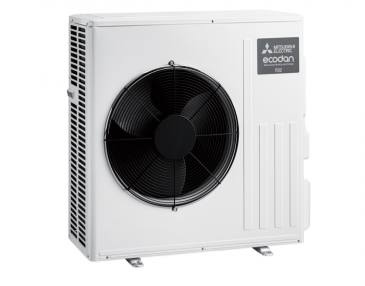
Mitsubishi Electric Ecodan 8.5kW Heat Pump (PUZ-WM85YAA)
The Mitsubishi Electric Ecodan PUZ-WM85YAA is a dedicated 400V, three-phase (3P+N+E) heat pump delivering an 8.5kW nominal thermal output, requiring a 16A Type C three-pole breaker. Within the complete Mitsubishi Ecodan heat pump range, the “YAA” suffix denotes this three-phase electrical architecture, ordering this unit for a standard domestic single-phase intake is an immediate site-stalling error.
- Supply Architecture: The YAA operates across 380–415V 3-phase, whereas the VAA variant runs on standard 230V single-phase, requiring a much larger 25A–32A single-pole breaker.
- Current Distribution: Maximum operating current is 13.0A balanced across three phases. This prevents the voltage drop and heavy sub-main cable sizing associated with high single-phase electrical draws.
- DNO Assessment & Compliance: Operating under 16A per phase aids standard DNO connection approval pathways, particularly on properties requiring G98/G99 notifications alongside existing microgeneration or battery storage.
- Refrigeration Architecture: Both models share an identical hermetically sealed, factory-charged R32 monobloc chassis (GWP 675), eliminating on-site F-Gas refrigeration pipework.
Performance Envelopes & COP vs. Building Heat Loss
The PUZ-WM85YAA delivers a certified COP of 4.80 at A7/W35, dropping to 3.51 at A2/W35, and maintains operational stability down to an ambient limit of -20°C. Supplying up to 60°C flow temperature without direct immersion backup, the unit is matched to properties with structural fabric transmission and ventilation losses falling strictly between 6.0kW and 8.5kW at a standard UK -2°C external design condition. Delivering nominal capacity requires 24.4 L/min primary flow through the heat exchanger (with a 10.8 L/min minimum cut-off). Sizing radiators to lower operating mean water temperatures and confirming index circuit authority via room-by-room heat loss calculations are critical steps to prevent short-cycling at minimum inverter modulation while guaranteeing design output during peak winter degree days.
| Model | Nominal Flow | Chassis (H×W×D) | Target Heat Loss Bracket (-2°C) |
|---|---|---|---|
| PUZ-WM60 (6.0kW) | 17.2 L/min | 715 × 840 × 330 mm | 3.5 kW – 5.9 kW |
| PUZ-WM85YAA (8.5kW) | 24.4 L/min | 1,020 × 1,050 × 480 mm | 6.0 kW – 8.5 kW |
| PUZ-WM112 (11.2kW) | 32.1 L/min | 1,020 × 1,050 × 480 mm | 8.6 kW – 11.2 kW |
Siting, Acoustic Compliance (MCS 020), & Clearances
Siting the 1,020mm (H) × 1,050mm (W) × 480mm (D), 98kg dry weight PUZ-WM85YAA requires strict adherence to physical service envelopes: maintain a minimum 300mm rear clearance from the evaporator coil to solid masonry, paired with 1,000mm unobstructed front discharge clearance to prevent cold-air recirculation. Lateral spacing demands 150mm to the left coil face and 500mm to the right service panel for piping and electrical terminal access.
Under UK Permitted Development, satisfying MCS 020 sound assessment requirements dictates that total sound pressure at the nearest neighbouring assessment position (a habitable room window) must not exceed 42 dBA. The unit produces a certified 60 dBA sound power level (BS EN 12102), translating to a free-field sound pressure level of 45 dBA at 1m.
When applying the MCS 020 calculation, directivity (Q) heavily impacts boundary positioning: mounting the chassis flat against an exterior wall sets Q=2, whereas siting within an enclosed corner or re-entrant recess increases directivity to Q=4, adding a 3 dB penalty. Under standard Q=2 geometry without line-of-sight acoustic barriers, distance attenuation achieves the mandatory 42 dBA threshold at approximately 3.0 meters from the receptor.
Primary Hydraulic Architecture & Freeze Protection
The PUZ-WM85YAA mandates a minimum of 28mm copper (or 32mm MLCP) across the entire primary run to sustain the 24.4 L/min nominal design flow. Dropping to 22mm accelerates fluid velocity beyond 1.5 m/s, spiking circuit resistance, eroding pump head, and inducing lockouts when flow approaches the 10.8 L/min minimum trip threshold. To isolate variable secondary circuit flow from this fixed primary requirement, apply [hydraulic separation and low-loss headers](https://www.google.com/search?q=/heat-pumps/low-loss-headers-vs-volumisers/)—or a plate heat exchanger where isolating contaminated heritage radiators is mandatory.
Install primary mechanical components between the outdoor monobloc and the FTC6 indoor interface in this sequence:
- Freeze Protection: Plumb 28mm mechanical anti-freeze valves vertically on exposed external flow and return tails, or charge the sealed system with a minimum 25% inhibited propylene glycol solution.
- Isolation & Debris Interception: Fit 28mm full-bore lever ball valves and an inline Y-strainer on the external pipe envelope adjacent to the unit.
- Magnetic Dirt Separation: Mount a high-volume magnetic cyclonic filter on the primary return before fluid enters the indoor building fabric.
- Hydraulic Decoupling: Connect into a low-loss header or close-coupled volumiser/buffer vessel to preserve minimum circuit volume for reverse-cycle defrosts.
- Secondary Distribution Pump: Install an auxiliary circulator (such as a Grundfos UPM3K 15-75) on the secondary header output, wired back to the FTC6 controller for modulation.
Mitsubishi Ecodan 8.5kW Heat Pump FAQs
What is the primary electrical difference between the PUZ-WM85YAA and PUZ-WM85VAA?”,
The PUZ-WM85YAA requires a 400V three-phase electrical supply protected by a 16A 3-pole circuit breaker, making it suitable for commercial properties or residential sites with upgraded supplies. The PUZ-WM85VAA is identical in thermal output (8.5kW) but runs on a standard UK domestic 230V single-phase supply with a 25A fuse rating.
What is the minimum primary pipe diameter for the Ecodan 8.5kW monobloc?
The PUZ-WM85YAA requires a minimum primary pipework size of 28mm copper (or 32mm composite/plastic barrier pipe). Dropping primary runs to 22mm restricts flow velocity below the 24.4 L/min design requirement, raising system hydraulic resistance and risking FTC6 low-flow error codes.
How does the PUZ-WM85YAA comply with MCS 020 planning rules regarding noise?
The unit generates a sound pressure level of 45 dBA at 1 metre and a sound power level (PWL) of 60 dBA. Under MCS 020 calculation standards for Permitted Development in England and Wales, the unit generally must be sited at least 2 to 3 metres away from an assessment point (a neighbour’s openable window) if unobstructed, or further if sound reflections from hard walls are present.
What is the minimum hydronic flow rate required to prevent Ecodan flow-switch errors?
The absolute minimum water flow rate for the 8.5kW monobloc is 10.8 L/min. If hydronic system resistance or TRVs close down circulation below this threshold, the internal flow switch will trip the FTC6 controller into an error state (such as P8 or L8) to protect the heat exchanger from thermal shock or freezing.
Can the PUZ-WM85YAA deliver high-temperature domestic hot water without an immersion boost?
The R32 PUZ-WM85YAA can achieve a maximum flow temperature of 60°C under heat-pump-only operation down to low ambient temperatures. For domestic hot water (DHW) pasteurisation cycles to protect against Legionella (raising water above 60°C), the system relies on the integrated cylinder immersion heater managed automatically through the FTC6 controller logic.
