
Who Are Ideal Heating? A 120-Year UK Heating Brand
Founded in 1906 in Hull, Ideal Heating is a staple British manufacturer with over 120 years of domestic engineering heritage. The company continues to operate its main manufacturing centre on the same East Yorkshire site, employing over 1,000 people across design, production, and field support. Keeping engineering and assembly strictly within the UK allows Ideal to maintain tight quality standards while designing heating systems built specifically for the quirks of British housing stock.
While millions of UK properties rely on their established gas boiler lines, most notably the Logic, Vogue and Independent ranges, Ideal has shifted substantial investment into electrified heating. The company executed a £60 million expansion at its Hull headquarters to construct dedicated heat pump testing facilities, increase assembly lines, and the Ideal Heating Expert Academy to help train thousands of engineers on hydronic system design. For installers and homeowners, UK-based production offers a distinct practical advantage when it comes to long-term aftercare and parts logistics. Rather than waiting on international shipping containers for replacement components, spare parts and dedicated technical advice remain accessible through nationwide merchant networks.
Table of Contents
The Ideal Heat Pump Range Explained (Logic Air ASHP)
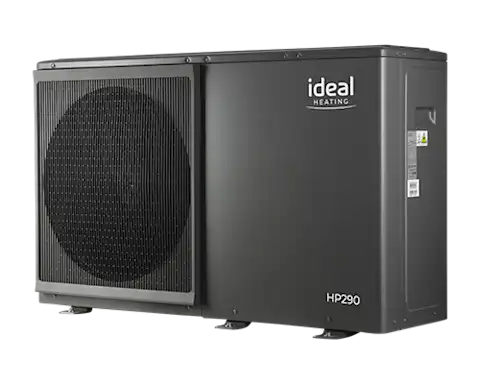
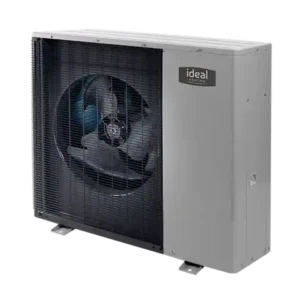
The Ideal Logic Air is an MCS-certified, air-to-water monobloc heat pump designed specifically for UK residential retrofits and new builds, which means installers can connect it directly to existing wet radiator or underfloor heating circuits. Because the entire heat-exchange process occurs within the single external heat pump casing, no high-pressure gas lines enter the property, making hydraulic integration straightforward for heating engineers.
- 4 kW: Suits small, highly insulated 1–2 bedroom flats or new builds because heat loss stays under 4 kW at peak winter design temperatures.
- 6 kW: Ideal for 2–3 bedroom semi-detached homes with moderate insulation because the heat pump matches typical 5–6 kW space-heating loads.
- 8 kW: Fits standard 3–4 bedroom detached properties because this output maintains flow temperatures during cold snaps without short-cycling.
- 10 kW: Designed for larger 4-bedroom family homes with higher hot water demand because it delivers greater thermal energy during cylinder reheat cycles.
- 12 kW: Suited to older, uninsulated 4–5 bedroom period properties because high thermal demand requires elevated low-ambient heat capacity.
- 16 kW: Targeted at large detached homes or multi-zone commercial retrofits because this sizing eliminates the need for cascade installations.
Monobloc units retain all fluorinated gas inside the factory-sealed outdoor casing, because water pipes (not refrigerant lines) run directly through the exterior wall. This means plumbers can complete the internal installation without an F-Gas qualification, reducing site labour time because there is no requirement to vacuum, pressure test, or flare copper refrigerant lines indoors. While initial models utilise R32 refrigerant, the industry transition toward R290 (propane) drops Global Warming Potential (GWP) from 675 to 3. This shift matters because R290 provides future-proofing against tightening F-Gas phase-down regulations, which means systems running natural refrigerants avoid chemical supply restrictions while achieving higher flow temperatures. View the full Logic Air specification sheets for exact hydraulic performance metrics.
Sizing Your Ideal Heat Pump: kW Output vs. Property Type
Correct heat pump sizing relies strictly on a room-by-room heat loss calculation rather than crude metrics like bedroom count, age, or overall floor area. Fabric thermal performance, air permeability rates, window glazing types, and regional design temperatures dictate real-world thermal demand. Estimating output without accurate room metrics risks system failure, making detailed space-heating calculations mandatory prior to specifying an Ideal Logic Air unit.
| kW Output | Typical Property | Approx. Heat Loss Range | Key Consideration |
|---|---|---|---|
| 4 kW | 1–2 bed flat or modern new build | 3.0 kW – 4.2 kW | Minimal flow temperature required for space heating |
| 6 - 8 kW | 3 bed semi-detached / mid-terrace | 5.5 kW – 8.0 kW | Verify existing radiator surface area suits low flow temps |
| 10 kW | 4 bed detached property (Post-1990) | 8.5 kW – 10.5 kW | Hot water cylinder recovery time dictates peak output load |
| 12 kW | 4–5 bed detached property (Pre-1990) | 8.5 kW – 10.5 kW | Emitter upgrades required to run low flow temperatures |
| 16 kW | Large period property / multi-zone | 13.0 kW – 16.5 kW | Confirm single-phase main supply fuses can handle load |
Over-sizing an installation causes rapid short-cycling, which severely degrades seasonal coefficient of performance (SCOP) efficiency and accelerates mechanical wear on the compressor. Conversely, under-sizing forces the system to rely on expensive direct-electric backup heaters, drastically inflating running costs during freezing conditions. Strictly following the MIS 3005 standard ensures heat pump capacity matches true thermal loss at local design temperatures. Calculate design loads using our free heat loss sizing guide.
Efficiency, SCOP Ratings & Real-World UK Performance
Coefficient of Performance (COP) measures instantaneous efficiency at a specific operating point, whereas Seasonal Coefficient of Performance (SCOP) evaluates total thermal energy produced against electrical power consumed over a complete heating season.
Ideal Logic Air models publish SCOP figures averaging ~4.5 at a 35 °C flow temperature (W35) and ~3.4 at 55 °C (W55), meaning the system returns between 3.4 and 4.5 units of heat energy for every 1 kWh of input electricity. In practical UK operation, winter climate conditions alter baseline efficiency because relative humidity averages above 80% from November through February. This high moisture content causes rapid frost build-up on the outdoor evaporator coil, triggering automated reverse-cycle defrosts to clear ice. Because electrical power is momentarily diverted to heat the external coil rather than the home, defrost cycles reduce effective real-world SCOP by 0.3 to 0.6 compared to EN14825 laboratory ratings – a natural thermodynamic reality of humid maritime weather rather than a mechanical defect. System flow temperature heavily influences running efficiency because compressor lift increases when heating water to higher temperatures. While Ideal monoblocs achieve flow temperatures up to 65 °C for hot water pasteurisation, compressor efficiency drops significantly above 50 °C. Designing emitter circuits with underfloor heating or low-temperature radiators keeps flow temperatures around 35 °C, which maximises seasonal efficiency and lowers ongoing electrical consumption. These efficiency metrics underpin the unit’s ErP energy labelling, where the range secures an A+++ rating at 35 °C space heating and A++ at 55 °C. For a detailed property breakdown, estimate projected electrical consumption using a UK heat pump running cost calculator.
Installation, MCS Certification & the Boiler Upgrade Scheme
- Conduct Room-by-Room Heat Loss Survey: An MCS-certified installer performs a comprehensive heat loss survey in accordance with MIS 3005 standards. This process calculates precise room-specific thermal demand, checks existing radiator surface areas against target low flow temperatures, and evaluates internal pipework diameters to ensure required hydraulic flow rates can be achieved.
- Submit BUS Voucher Application: The installer applies for the £7,500 Boiler Upgrade Scheme (BUS) grant on the homeowner’s behalf through the Ofgem portal (available across England and Wales). To qualify, the property must possess a valid Energy Performance Certificate (EPC) with no outstanding recommendations for loft or cavity wall insulation.
- Complete Physical Equipment Installation: Over a typical installation duration of 2 to 3 days, contractors mount the monobloc outdoor heat pump unit onto a solid ground-level concrete plinth or external wall brackets. The team connects insulated hydraulic pipework indoors, installing a buffer vessel, a specialised heat pump hot water cylinder, and system controls.
- Commission and Register System: The engineer balances system hydraulics, sets appropriate weather compensation curves based on local outdoor winter design temperatures, and configures defrost cycle parameters. Once operational checks pass, the installer registers the heat pump unit directly with Ideal Heating to log the installation for warranty purposes.
- Issue MCS Certification and Redeem Grant: Following successful commissioning, the installer issues a formal MCS certificate and handover pack to the homeowner. The £7,500 BUS voucher is then redeemed directly with Ofgem, which reduces the final invoice balance upfront without requiring the homeowner to claim funds back.
Selecting contractors from Ideal’s accredited installer network guarantees that technicians have completed specialised Expert Academy training on monobloc hydraulic integration. When installed and commissioned by an accredited partner, Ideal extends standard warranty coverage up to 10 years on parts and labour, subject to annual servicing. Search our directory to find an Ideal-accredited heat pump installer near you.
Reliability, Warranty & Common First-Year Considerations
Ideal Heating provides a 7-year parts and labour warranty as standard on the Logic Air range, which extends to 10 years when commissioned and registered by an Ideal Accredited Installer. Maintaining validity requires annual servicing by a qualified technician, strict adherence to system water quality standards, and prompt warranty registration within thirty days of setup.
What to Monitor in Year One
- Flow temperature sensor calibration drift: Thermal sensor drift creates minor discrepancies between target and actual hydronic flow temperatures, manifesting as inconsistent room temperatures across zones. Identifying sensor variance and recalibrating the circuit requires a simple diagnostic check outlined in our Ideal heat pump annual servicing guide.
- Defrost cycle frequency in humid UK winters: Operating near 0 °C in typical 90% relative humidity, running 4 to 6 defrost cycles per hour is normal thermodynamic operation. If the system cycles more frequently, check the outdoor unit for leaf debris, ice build-up, or localised airflow obstructions around the evaporator fins.
- Magnetic/system filter saturation: High mineral density across hard water areas in South and East England accelerates magnetite capture. Ideal mandates installing a minimum 22 mm magnetic system filter; neglecting filter maintenance restricts hydraulic flow rates, places excess strain on the circulating pump, and voids heat exchanger warranty protection.
- Weather compensation curve tuning: Factory weather compensation settings lean conservative, frequently running higher flow temperatures than the building requires. Request an installer adjustment to the heat curve slope after your first month of real-world winter operation to maximise low-temperature efficiency and lower electrical consumption.
Ideal Heat Pumps vs. Gas Boilers: When Does Each Make Sense?
Because Ideal Heating manufactures both low-carbon heat pumps and gas boilers, selecting between these two technologies relies strictly on property characteristics rather than brand preference. Building fabric thermal performance, site energy infrastructure, and immediate project capital dictate which system provides the most practical and economical heating solution for any given UK property.
| Factor | Heat Pump Favours | Gas Boiler Favours |
|---|---|---|
| Insulation Level | Properties with moderate to high thermal efficiency (EPC A–C) | Uninsulated properties with significant peak space-heating loss |
| Fuel Access | Off-gas grid locations currently using heating oil, LPG, or electric | Established property connections to the national mains gas grid |
| Upfront Cost (Post-BUS) | Higher net capital investment (£2,500–£5,000+ net after grant) | Lower initial capital outlay for equipment and installation labor |
| Running Cost | Lower running costs when paired with flexible time-of-use tariffs | Running costs tied directly to standard prevailing gas unit rates |
| Carbon Footprint | Zero direct site emissions produced during daily heating cycles | Fossil fuel combustion resulting in localized carbon emissions |
Off-grid rural properties currently relying on oil, LPG, or electric resistance heating stand to secure the most immediate operational and financial advantages by switching to an air source heat pump. Conversely, urban properties connected to mains gas, where initial capital outlay remains the primary constraint, may still favor Ideal’s gas boiler range (Logic, Vogue, Independent) for a straightforward and low-cost system replacement.
Frequently Asked Questions
Are Ideal Logic Air heat pumps MCS certified and BUS eligible?
Yes. All Ideal Logic Air ASHP units carry MCS certification (MIS 3005 compliant) and qualify for the £7,500 Boiler Upgrade Scheme grant in England and Wales, provided the installing engineer is MCS-registered and the property holds a valid EPC with no outstanding insulation recommendations.
What is the difference between R32 and R290 refrigerant in Ideal heat pumps?
R32 has a Global Warming Potential (GWP) of 675; R290 (propane) has a GWP of 3. Ideal is transitioning select Logic Air models to R290 to comply with tightening EU/UK F-gas regulations. R290 units also permit slightly higher flow temperatures without efficiency penalty.
Can an Ideal heat pump work with existing radiators?
Yes, provided radiators are sized for a 45–50 °C flow temperature rather than the 70–80 °C typical of gas boilers. Ideal Logic Air units deliver up to 65 °C flow, but SCOP drops from approximately 4.5 at W35 to 3.4 at W55. Oversized or low-temperature radiators are recommended for optimal efficiency.
Does hard water affect Ideal heat pump warranty?
Indirectly, yes. Ideal’s installation specification mandates a minimum 22 mm magnetic system filter. In hard water regions (South and East England, 200+ ppm CaCO3), failure to install and annually service this filter can cause plate heat exchanger scaling, which is classified as installation negligence and voids the heat exchanger warranty component.
