
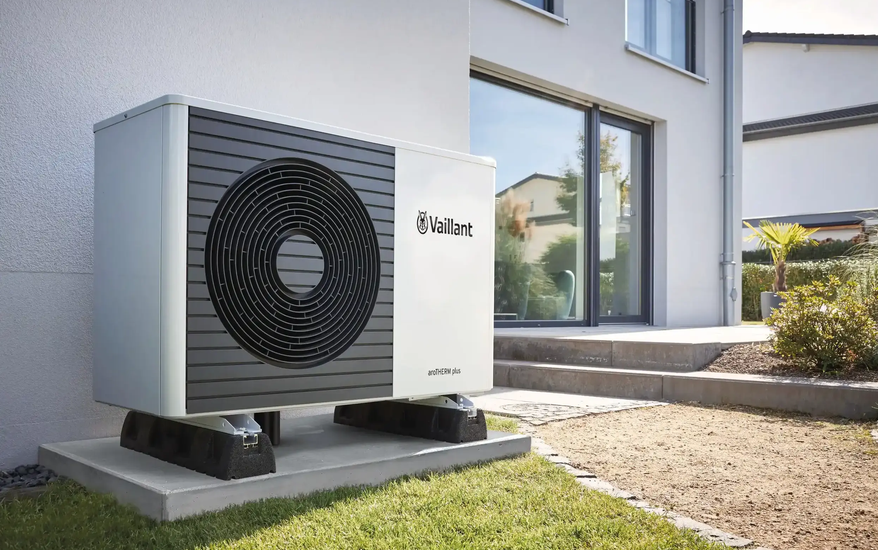
Vaillant Arotherm Plus 10kW at a Glance
Table of Contents
The Vaillant aroTHERM Plus 10kW (model 0010037214) is a 10.0 kW air-to-water monobloc heat pump designed for 3–4 bedroom detached and semi-detached properties with an estimated annual heat demand between 12,000 and 18,000 kWh. Positioned within the broader Vaillant Arotherm Plus range overview, this single-phase outdoor unit serves as a direct low-carbon alternative to traditional 24–30 kW gas or oil boilers. The unit qualifies for the £7,500 Boiler Upgrade Scheme (BUS) grant across England and Wales when commissioned by an MCS-certified installer on properties with an eligible Energy Performance Certificate.
- Nominal Heat Output: 10.0 kW (at A7/W35, EN 14511) with a modulating heating capacity range of 2.6 – 10.0 kW
- Seasonal Coefficient of Performance (SCOP): 4.60 at W35 and 3.52 at W55 under average climate conditions
- Maximum Flow Temperature: 75°C (enabling operational suitability with existing radiator circuits)
- Refrigerant Type: R290 propane (GWP 3, 1.48 kg charge weight, A3 safety classification)
- ErP Energy Efficiency Class: A+++ for low-temperature heating (W35) and A++ for medium-temperature heating (W55)
Who Is the 10kW Model Right For?
Property Size, Construction & Heat Demand
The Vaillant aroTHERM Plus 10kW suits medium-to-large 3–4 bedroom detached or semi-detached UK homes with a calculated peak space-heating demand between 12,000 and 18,000 kWh annually.
Your post-1990 build or cavity-insulated semi-detached home matches this 10kW capacity directly. Properties with double glazing and 270 mm loft insulation typically produce a peak heat loss of 7–9.5 kW at standard UK winter design temperatures (-3°C). The modulating 2.6–10.0 kW output covers this heat requirement efficiently without short-cycling during milder shoulder months.
Renovated 1930s solid-wall homes qualify for this unit once external or internal wall insulation reduces fabric transmission losses. While uninsulated 9-inch brickwork creates heat losses exceeding 12 kW, retrofitted wall insulation lowers the space-heating demand into the 8–10 kW bracket. This retrofit brings your home’s thermal envelope safely within the unit’s continuous output range.
Off-gas-grid homes replacing 24–30 kW oil or LPG boilers are prime candidates for this monobloc. Fossil boilers were oversized for instantaneous hot water, whereas actual continuous space-heating loads rarely exceed 9 kW. Paired with a dedicated cylinder, the 10kW heat pump replaces fossil systems cleanly without requiring severe emitter upgrades across your primary heating circuits.
If your home meets any of these criteria, step up to the 12kW Arotherm Plus:
- Calculated heat loss exceeds 10.5 kW: Confirmed by room-by-room BS EN 12831 calculations at your regional outdoor design temperature.
- Large 5-bedroom detached builds: Properties exceeding 200 m² of usable floor space with high concurrent domestic hot water demand.
- Unretrofitted pre-1960s housing: Solid-wall or uninsulated cavity properties lacking modern double glazing and loft insulation upgrades.
10kW vs 7kW vs 12kW: Choosing the Correct Output
| Model | Best-Suited Heat Demand (kWh/yr) | Typical Property |
|---|---|---|
| aroTHERM Plus 7kW | 8,000 – 12,000 | 2–3 bed semi-detached, post-2000 build or well-insulated retrofit |
| aroTHERM Plus 10kW | 12,000 – 18,000 | 3–4 bed detached or semi-detached, post-1990 build |
| aroTHERM Plus 12kW | 18,000 – 25,000 | 4–5 bed detached, large footprint, or higher design heat loss |
Under-sizing an installation leaves the compressor running continuously at maximum frequency without satisfying room thermostats during peak winter design conditions. This persistent high-load operation accelerates mechanical wear, triggers auxiliary direct-electric immersion heaters, and causes severe seasonal performance (SCOP) degradation. To prevent overloading a system, select the 8kW model for smaller properties only when verified room-by-room heat-loss totals fall strictly within its design window.
Over-sizing increases upfront equipment capital costs and raises the lowest modulation floor (2.6 kW on the 10kW unit). During milder shoulder months, an oversized unit cannot throttle down sufficiently to match low baseline heat loads, resulting in frequent on-off cycling and reduced operating efficiency.
Technical Specifications & Performance Data
Output, Efficiency & Operating Range
| Parameter | Value |
|---|---|
| Nominal Heat Output (EN 14511, A7/W35) | 10.0 kW |
| Modulating Heating Capacity Range | 2.6 – 10.0 kW |
| Seasonal Coefficient of Performance (SCOP at W35) | 4.60 |
| Seasonal Coefficient of Performance (SCOP at W55) | 3.52 |
| Coefficient of Performance (COP at A7/W35) | 4.87 |
| Coefficient of Performance (COP at A2/W35) | 3.65 |
| Coefficient of Performance (COP at A7/W55) | 3.22 |
| Maximum Flow Temperature | 75°C |
For most UK retrofits, the W55 figure is the one that matters. Existing radiator circuits designed for higher-temperature boilers operate efficiently at a 55°C flow temperature, delivering a reliable COP of 3.22 in typical heating conditions. The unit’s 75°C maximum flow temperature prevents the need to replace every existing radiator, maintaining domestic hot water performance and comfort without full emitter replacement, as outlined in our full Arotherm Plus technical breakdown.
R290 Propane Refrigerant: Efficiency & Safety Clearances
The Vaillant aroTHERM Plus 10kW uses R290 (pure propane), a natural refrigerant with a Global Warming Potential (GWP) of just 3. Compared to legacy fluorinated refrigerants like R410A, which carries a damaging GWP of 2,088, R290 ensures long-term regulatory compliance under tightening environmental quotas while substantially reducing lifecycle carbon emissions.
Thermodynamically, R290 possesses superior volumetric heating capacity and heat-transfer characteristics compared to synthetic blends. This allows the 10kW unit to sustain flow temperatures up to 75°C and maintain higher seasonal COP figures during sub-zero ambient conditions without stressing the inverter-driven compressor. Review the R290 refrigerant explained in our Arotherm Plus guide for full system schematics and technical calculations.
Because R290 carries an A3 flammable safety classification, installations must strictly follow BS EN 378 requirements for the 1.48 kg charge. Outdoor units require a clear 1-metre safety zone away from ground-floor windows, external air vents, and untrapped drainage points. Installing the unit in enclosed, unventilated alcoves or glazed balconies is strictly prohibited.
- Installer must hold valid F-gas / R290 competency certification.
Noise Levels & Planning Considerations
The outdoor unit generates a sound power level of 54 dB(A), producing an operating sound pressure level at 3 metres of 33 dB(A) in standard mode and 28 dB(A) in quiet mode.
At 3 metres in quiet mode, the unit is quieter than a modern domestic refrigerator compressor running in a quiet kitchen, which typically registers between 35 and 40 dB(A). For outdoor spaces, this low acoustic output ensures background ambient noise and conversation easily mask compressor operation during day and night cycles.
This acoustic profile complies with MCS 020 planning standards, qualifying most domestic installations in England for permitted development without separate planning consent. Permitted development frameworks in Scotland and Wales maintain distinct boundary constraints, and wall-mounting on residential flats requires formal local authority consent. Review full siting guidelines in our Arotherm Plus installation requirements.
- Check with your local planning authority or MCS installer before installation if siting within 1 metre of a neighbouring boundary.
Installation, Controls & System Pairing
Compatible Indoor Units & Buffer Requirements
Proper hydraulic design requires matching the aroTHERM Plus 10kW outdoor monobloc with compatible [indoor unit options across the Arotherm Plus range](https://www.google.com/search?q=/vaillant/arotherm-plus/) to manage defrost cycles, domestic hot water, and system flow rates.
- Vaillant uniTOWER plus VH 70/6 S3: A floor-standing indoor unit with an integrated 190-litre unvented domestic hot water cylinder and built-in hydraulic separation components.
- Vaillant auroCOMPACT VSC S 296/2: A dedicated 190-litre hot water storage option suitable for properties requiring flexible plant room layouts or separate hydraulic interfaces.
Vaillant specifies an absolute minimum active system water volume of 110 litres to support defrost cycles without tripping high-pressure limits. Applying the standard sizing rule of 50 litres per kW requires a 500-litre buffer volume, which prevents compressor cycling under low thermal loads and stabilizes circulation rates across variable-temperature emitter circuits.
- System Protection: Fit a magnetic filter (such as a SpiroTrap MB3 or MagnaClean Professional) and dose with Fernox F1 or Sentinel X100 inhibitor, especially in Thames Water, Southern, or Anglian hard-water zones to safeguard the heat exchanger from scale and magnetite accumulation.
Controls: sensoCOMFORT VRC 720 & Smart Connectivity
For optimal seasonal performance, we specify the weather-compensated sensoCOMFORT VRC 720 controller over the basic sensoHOME VRC 710, with full Vaillant control options detailed in our Arotherm Plus review.
Weather compensation dynamically adjusts the flow temperature based on real-time external temperature readings. By calculating the exact heat-loss curve of the building, the heat pump runs at the lowest required water temperature to satisfy room demand. This continuous modulation keeps seasonal COP high, reduces compressor cycling, and eliminates wasteful high-temperature spikes typical of standard on/off thermostats.
- sensoNET VRT 920 Gateway: Connects the heating system to local Wi-Fi, enabling remote scheduling, energy consumption tracking, and operational adjustments via the myVAILLANT mobile application.
- BDR91 Relay Compatibility: Integrates with third-party wireless relays to switch existing 230V two-port motorised zone valves during retrofit installations without requiring full system rewiring.
Costs, Grants & Running Economics
Purchase Price, Installation Cost & the £7,500 BUS Grant
Total capital expenditure for the aroTHERM Plus 10kW depends on system architecture, electrical supply requirements, and hot water cylinder selection. Homeowners in England and Wales can offset upfront installation costs through the Boiler Upgrade Scheme (BUS).
| Stage | Estimated Cost Range (inc. VAT) |
|---|---|
| Supply only (inc. VAT) | £4,200 – £4,800 |
| Full installed system | £11,000 – £14,500 |
| Net cost after £7,500 BUS grant | £3,500 – £7,000 |
Under the BUS framework in England and Wales, your MCS-certified installer applies for funding directly through the Ofgem portal. The £7,500 grant is deducted at the point of sale from your quotation, removing the need for retrospective homeowner rebate claims. Qualifying properties must have an Energy Performance Certificate (EPC) issued within the last ten years with no outstanding recommendations for loft or cavity wall insulation. Installers must complete commissioning and register the MCS compliance certificate within 90 days of voucher generation, as detailed in our full Arotherm Plus cost breakdown.
Grant Stacking Restrictions: The Boiler Upgrade Scheme cannot be combined with other public-funded retrofit grants, such as the Home Upgrade Grant (HUG) or Energy Company Obligation (ECO4) funding. Check regional eligibility criteria with your installer before signing contracts.
Annual Running Cost Estimate (UK 2025 Tariffs)
Based on a standard three-bedroom semi-detached home with an annual thermal demand of 14,000 kWh and typical 2025 utility tariffs:
- 14,000 kWh ÷ 3.5 blended COP = 4,000 kWh annual electrical input required.
- 4,000 kWh × £0.28 per kWh = £1,120 total annual electricity expenditure.
- Gas equivalent calculation: 14,000 kWh × £0.065 per kWh = £910 per year; this nominal operating cost gap narrows or closes completely when leveraging domestic solar PV generation or flexible, off-peak time-of-use tariffs.
At an increased seasonal COP of 4.0 or higher, readily achievable during milder winter weather and low-temperature W35 design parameters, annual electrical demand drops to 3,500 kWh, reducing total running costs to £980. Examining Arotherm Plus efficiency in real-world conditions demonstrates how precise system design, tailored weather compensation curves, and correctly sized heat emitters drive seasonal performance figures high enough to match or outperform standard gas heating operating expenses.
Warranty, Servicing & Long-Term Ownership
The Vaillant aroTHERM Plus 10kW includes a baseline two-year manufacturer parts and labour warranty, providing standard protection against equipment defects when commissioned according to statutory UK benchmark standards.
Selecting an accredited Vaillant Advance contractor unlocks essential extended protection. When your installer registers the completed installation within 30 days of commissioning, manufacturer coverage expands to 5 years for parts and labour, accompanied by a 10-year extended warranty on the compressor.
- Condenser Fins: Visually inspect the outdoor coil for debris build-up, physical damage, or salt-induced corrosion.
- Magnetic Filter: Isolate and clean the magnetic system filter to eliminate circulating magnetite and sludge.
- System Pressure: Confirm the primary hydraulic circuit maintains a cold static pressure of 1.0–1.5 bar.
- Condensate Drain: Check the 32 mm discharge pipe to prevent blockages during automatic defrost cycles.
To protect your warranty and preserve system efficiency, consult our Vaillant Arotherm Plus servicing guide and book your mandatory annual inspection with an MCS-certified Vaillant installer.
Frequently Asked Questions
What size property suits the 10kW?
The 10kW model suits medium-to-large 3–4 bedroom detached or semi-detached homes with an annual heat demand of 12,000 to 18,000 kWh. It matches post-1990 builds or insulated retrofits with a calculated peak heat loss not exceeding 10.0 kW at UK winter design temperatures.
Can it replace a 24kW combi boiler without changing radiators?
Yes, it frequently replaces 24–30 kW boilers without replacing all emitters due to its 75°C maximum flow temperature. However, existing radiators must satisfy room heat losses at design flow temperatures; review our radiator compatibility guidance to confirm individual room emitter outputs at ΔT30.
Is R290 refrigerant safe?
R290 is safe when installed by qualified engineers adhering to BS EN 378 standards. Although classified as an A3 flammable refrigerant, its small 1.48 kg sealed charge operates outdoors and requires simple 1-metre safety clearances from untrapped drains, doors, and opening ground-floor windows.
How much does installation cost after the BUS grant?
Net installation costs typically range between £3,500 and £7,000 following the £7,500 Boiler Upgrade Scheme grant deduction. Total gross turnkey installation costs, including an unvented hot water cylinder, system filter, weather compensation controls, and commissioning, generally sit between £11,000 and £14,500 before grant application.
What warranty does Vaillant offer?
Vaillant provides a standard two-year parts and labour warranty on all aroTHERM Plus units. Registering the system through an accredited Vaillant Advance installer within 30 days of commissioning extends the warranty to 5 years for parts and labour, alongside a 10-year compressor warranty.
