
What Is the Vaillant Arotherm Plus Air Source Heat Pump?
Table of Contents
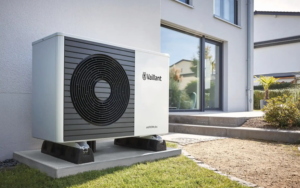
The Vaillant aroTHERM plus is an air-to-water monobloc heat pump engineered for domestic central heating and hot water production. Utilising natural R290 refrigerant across capacities from 4 kW to 15 kW (4, 5, 6, 8, 10, 12, and 15 kW), the system achieves an ErP A+++ efficiency rating at a 35 °C flow temperature. An air source heat pump installation houses the hermetically sealed refrigerant circuit entirely outdoors, circulating system water directly into the property.
- GWP = 3 Refrigerant: Operates on R290 (propane) with a Global Warming Potential of 3 and a factory charge under 1.5 kg, sitting below UK F-Gas quota restrictions.
- 75 °C Maximum Flow Temperature: Produces water flow temperatures up to 75 °C for existing radiator networks and domestic hot water cylinders without supplemental direct-electric immersion heating.
- SCOP Up to 5.0: Delivers a Seasonal Coefficient of Performance up to 5.0 at W35 flow and up to 4.6 at W55 flow conditions.
- Operational Down to −25 °C: Maintains heat generation across ambient outdoor temperatures from −25 °C to +40 °C, sustaining a COP of ~3.1 at A-7/W35.
Acoustic output ranges between 48 and 54 dB(A) sound power, yielding sound pressure levels of 28–33 dB(A) at 3 metres. Single-phase 230 V connections power units up to 10 kW, while 12 kW and 15 kW models require 400 V three-phase supply.
| Model | Nominal Output | Typical Design Heat Loss | Best Suited Property Profile | Electrical Supply |
|---|---|---|---|---|
| aroTHERM Plus 3.5 kW (VWL 35/6) | 3.5 kW | Up to ~3.5 kW | Highly insulated new builds, well-insulated 1–2 bed flats, or small energy-efficient bungalows | Single-phase (230V) |
| aroTHERM Plus 5 kW (VWL 55/6) | 5.0 kW | ~3.5 kW – 5.0 kW | Modern 2–3 bed terraced or semi-detached homes, well-insulated retrofits, and mid-sized bungalows | Single-phase (230V) |
| aroTHERM Plus 7 kW (VWL 75/6) | 7.0 kW | ~5.0 kW – 7.0 kW | Average 3–4 bed semi-detached or detached properties with standard cavity wall and loft insulation | Single-phase (230V) |
| aroTHERM Plus 10 kW (VWL 105/6) | 10.0 kW | ~7.0 kW – 10.0 kW | Larger 4–5 bed detached homes, older/uninsulated solid wall properties, or high hot water demand homes | Single-phase (230V) or 3-Phase (400V) |
| aroTHERM Plus 12 kW (VWL 125/6) | 12.0 kW | ~10.0 kW – 12.0 kW | Substantial detached homes, period/stone properties, or light commercial/large domestic setups | Single-phase (230V) or 3-Phase (400V) |
Key Sizing Considerations for Customers
- Heat Loss vs. Floor Area: Sizing depends entirely on peak heat loss calculations (BS EN 12831), not just square meterage or bedroom count.
- Low Modulation: Because the 3.5 kW and 5 kW share the same chassis/compressor base, and the 10 kW and 12 kW share a twin-fan chassis, turn-down ratios and minimum modulating outputs are virtually identical within those pairs.
- Flow Temperatures: Sizing estimates assume standard design flow temperatures (35°C–50°C); systems running on existing high-temperature radiators may require a dedicated radiator schedule review or a larger unit.
7 Key Benefits of Choosing the Vaillant Arotherm Plus
R290 Natural Refrigerant – GWP 3 vs. 2,088 (R410A)
R290 propane refrigerant protects heating systems against future UK F-Gas phase-down legislation. With a Global Warming Potential of 3 and a charge under 1.5 kg, R290 substantially outperforms legacy R410A with its GWP of 2,088. This natural refrigerant eliminates phase-out replacement risks across the system’s operational lifespan.
75 °C Flow Temperature – Retrofit Existing Radiators
High 75 °C flow capability allows installation directly into existing radiator circuits without costly emitter upgrades. The aroTHERM plus delivers 75 °C flow water purely via thermodynamic compression without engaging direct-electric immersion back-up elements. Homeowners retain existing pipework and standard radiators while running automated 70 °C legionella protection cycles in hot water cylinders.
Whisper-Quiet Operation – 28 dB(A) at 3 m
Low acoustic output ensures compliance with Permitted Development noise criteria in compact residential spaces. Sound pressure drops to 28–33 dB(A) at 3 metres, derived from an operational sound power level between 48 and 54 dB(A). The outdoor unit operates at sound levels comparable to a domestic refrigerator, preventing planning permission and boundary disputes.
A+++ ErP & SCOP up to 5.0
High seasonal efficiency extracts up to five units of heat energy for every electrical unit consumed. Testing demonstrates a Seasonal Coefficient of Performance up to 5.0 at W35 flow conditions, securing the maximum ErP A+++ rating. Operating at COP 5.4 under A7/W35 conditions offsets standard UK electricity tariffs to deliver running costs competitive with mains gas.
Single Monobloc Unit – No Refrigerant Pipe Runs On-Site
Hermetically sealed monobloc architecture eliminates on-site refrigerant handling and indoor F-Gas pipework. The entire R290 circuit is sealed at the factory, routing standard insulated flow and return water connections directly into the property. External hydronic connections simplify maintenance, prevent internal refrigerant leak risks, and reduce on-site labour hours.
sensoCOMFORT Smart Controls & myVAILLANT App
Intelligent weather-compensated controls optimise flow temperatures dynamically to minimise grid electrical draw. The sensoCOMFORT VRC 720 and multiMATIC 700 controllers pair with the myVAILLANT app for energy monitoring and scheduled heating profiles. System automation continuously matches output to outdoor ambient shifts down to −25 °C, maintaining interior comfort without manual intervention.
MCS Certified – Eligible for £7,500 BUS Grant
MCS certification enables access to government capital funding to offset upfront installation costs. The aroTHERM plus qualifies for the £7,500 Boiler Upgrade Scheme grant across England and Wales on eligible properties. This non-repayable incentive lowers typical £11,000–£16,000 project costs to a net outlay between £3,500 and £8,500.
Vaillant Arotherm Plus vs. Daikin, Mitsubishi & LG – Full Comparison
This evaluation compiles verified technical specifications from manufacturer engineering data sheets across 2024 and 2025 product cycles. Heating engineers assess air-to-water heat pumps based on seasonal thermodynamic efficiency, acoustic pressure boundaries, refrigerant environmental metrics, and operating flow thresholds. Hardware selection and component sizing require property-specific room-by-room heat-loss calculations in accordance with CIBSE and MCS design standards. For broader market analysis across competing configurations, review our comprehensive heat pump comparison guide.
The technical data highlights clear engineering differences. The Vaillant aroTHERM plus and LG Therma V operate on R290 propane with a GWP of 3, eliminating exposure to F-Gas quota phase-downs affecting R32 units (GWP 675). Vaillant’s 75 °C maximum flow capability delivers sufficient mean water temperature to heat high-heat-loss period homes without requiring comprehensive radiator replacements. However, Daikin’s Altherma 3 H HT retains an engineering advantage in low-load turn-down ratio; its scroll compressor achieves wider part-load inverter modulation down to lower minimum thermal outputs, reducing compressor cycling during mild shoulder-season days (10–15 °C ambient).
- Victorian Terraces: The aroTHERM plus delivers 75 °C flow to support original high-temperature radiator circuits without extensive pipework modification.
- New-Build Properties: Sizing depends on minimum design heat loss; low-capacity 4–6 kW units paired with underfloor heating maximise SCOP efficiency up to 5.0.
- Off-Grid Rural Properties: Selection depends on electrical supply capacity; single-phase homes requiring high thermal output benefit from Vaillant’s 10 kW single-phase limit before requiring 400 V three-phase upgrades.
Is the Arotherm Plus Right for Your Home?
Run through these technical and spatial property checks before requesting an on-site survey to confirm suitability for a Vaillant aroTHERM plus installation across UK homes.
- Outdoor Spatial Clearance: Does your property have at least 300 mm rear clearance and 1,000 mm front discharge clearance on a solid, level ground surface or suitable mounting bracket?
- Electrical Supply Infrastructure: Is your property connected to a standard 230 V single-phase supply for units up to 10 kW, or a 400 V three-phase supply for 12 kW and 15 kW models?
- Radiator Sizing & Design Flow: Have existing radiators been assessed to deliver design room temperatures at 55 °C flow, or will the installation run at higher 70–75 °C flow settings?
- EPC Insulation Standards: Does your property hold a valid Energy Performance Certificate with no outstanding recommendations for cavity-wall or loft insulation to satisfy BUS grant criteria?
- Cylinder Footprint & Pipe Routes: Is there dedicated interior space for an unvented heat pump hot water cylinder and buffer vessel with a clear route for external insulated pipework?
- Permitted Development Criteria: Is the external unit location compliant with MCS 020 acoustic calculation standards and positioned away from principal elevations facing a public highway?
- Water Quality & Hardness: In hard-water supply areas exceeding 200 mg/L CaCO₃, is your primary hydronic system protected with an inline magnetic filter and scale inhibitor?
- Current Primary Fuel Source: Are you displacing an off-grid fuel source such as heating oil, bulk LPG, direct-electric heating, or an inefficient mains gas boiler?
- Annual Heating Demand: Is your total space heating and domestic hot water demand documented in annual kWh from past fuel bills to determine accurate heat-loss sizing?
If you’d like to gain a quick estimate on your properties requirements, try our free heat pump size calculator.
Vaillant aroTHERM Plus Hybrid Systems: Pairing with Existing Boilers
For properties with high peak heat loss, limited electrical capacity, or where replacing a recently installed boiler doesn’t make financial sense, the aroTHERM plus can be deployed as a hybrid heat pump setup. Paired with a combi or system boiler (gas, LPG, or oil) via the sensoCOMFORT VRC 720 controller and a low-loss header or decoupling cylinder, the system uses Vaillant’s triVAI energy management algorithm. By inputting your real-time electricity and fuel tariffs, triVAI automatically calculates the economic bivalent point: running the heat pump during mild conditions when COP is highest, and dynamically switching over to the boiler when sub-zero ambient temperatures make fossil fuels cheaper per kWh delivered.
While hybrid installations do not qualify for the £7,500 Boiler Upgrade Scheme (BUS) grant (which mandates the complete removal of fossil fuel appliances), they eliminate the need for costly radiator up-sizing or consumer unit upgrades, serving as a practical stepping stone for hard-to-decarbonise homes.
Vaillant Arotherm Plus Installations – What to Expect
- Pre-Install Heat-Loss Survey & MCS Assessment
Execute a room-by-room CIBSE heat-loss calculation and comprehensive MCS property assessment. Qualified engineers verify fabric heat transmission, ventilation losses, and existing radiator surface areas to calculate peak thermal demand and size the specific aroTHERM plus kW capacity required for Building Regulations Part L compliance. - DNO Notification & Electrical Infrastructure
Submit an electrical application to the local Distribution Network Operator (DNO) prior to installation energisation. Single-phase units up to 10 kW require a dedicated consumer unit breaker and isolator, whereas larger 12 kW and 15 kW models require verified 400 V three-phase supply approval. - Outdoor Unit Siting & Ground Preparation
Secure the monobloc chassis onto heavy-duty anti-vibration ground mounts over a level concrete base. Maintain at least 300 mm rear wall clearance, provide 1,000 mm unobstructed forward discharge space, and route the condensate drainage directly into an insulated soakaway or drain to prevent winter icing. - Indoor Hydraulic Connections & System Filtration
Connect external flow and return lines into the interior distribution network using insulated 28 mm copper pipework to sustain design flow rates. Integrate an inline magnetic system filter, automatic bypass valve, and appropriately sized buffer vessel to prevent heat pump short-cycling and protect primary heat exchangers. - Commissioning, Refrigerant Safety & Control Setup
Conduct R290 seal integrity inspections and balance system flow rates across all primary hydraulic circuits using calibrated flow meters. Programme the sensoCOMFORT VRC 720 or multiMATIC 700 controller with property-specific weather-compensation heating curves, target flow temperatures, and hot water cylinder schedules. - Handover, Certification & BUS Grant Sign-Off
Review the completed heat pump installation process during a technical on-site client walkthrough. Engineers issue the Building Regulations Part L compliance certificate, provide official MCS documentation, and submit final paperwork to secure and release the £7,500 Boiler Upgrade Scheme grant funding.
Arotherm Plus Running Costs & BUS Grant Savings
A typical 4-bed UK semi with an annual heating demand of 12,000 kWh operating an 8 kW aroTHERM plus at an SCOP of 4.5 consumes 2,667 kWh of electricity, resulting in annual running costs of approximately £663 at a 24.86 p/kWh unit rate. In comparison, standard mains gas at 6.34 p/kWh costs £760 to £845 per year, heating oil costs approximately £1,450 per year (a £787 annual saving), and direct-electric systems cost £2,983 per year (a £2,320 annual saving). Custom tariff projections can be calculated with our heat pump running costs calculator.
The £7,500 Boiler Upgrade Scheme (BUS) grant is deducted directly from the gross installation invoice for eligible owner-occupied properties in England and Wales. Standard turnkey installations for an 8 kW to 12 kW system range from £11,000 to £16,000 prior to incentives. Applying the £7,500 BUS grant establishes a net homeowner outlay of £3,500 to £8,500, shortening capital payback against heating oil to under 5 years.
Maintaining the extended 7-year manufacturer parts-and-labour warranty requires an annual system service by a Vaillant Advanced installer, costing between £180 and £220 per year to verify glycol concentration, clean inline magnetic filters, and record system pressures. Properties located in Scotland access capital funding via the Home Energy Scotland scheme rather than the BUS voucher mechanism.
Frequently Asked Questions
Yes. The Arotherm Plus delivers flow temperatures up to 75 °C, which is high enough to drive standard UK radiators sized for gas boilers. Most 3- and 4-bed properties keep their existing emitters; only oversized or single-panel radiators in poorly insulated rooms may need upgrading.
A typical UK 3-bed semi with a heat loss of 6–8 kW usually suits the 6 kW or 8 kW Arotherm Plus model. An MCS-accredited installer must perform a room-by-room heat-loss survey (BS EN 12831) to confirm the correct output before specifying.
Yes. The Arotherm Plus is a sealed monobloc, so the R290 charge (≤ 1.5 kg) never enters the home. The unit sits outdoors, and R290’s GWP of 3 makes it over 690 times less harmful than R410A. Vaillant’s design meets EN 378 and UK F-Gas regulations.
In most cases, no. Air source heat pumps fall under Permitted Development in England, provided the unit is not installed on the principal elevation facing a highway, meets the 1-metre boundary noise limit, and is the only ASHP on the property. Scotland and Wales have separate rules.
Vaillant requires one service per year to maintain the extended 7-year warranty. A Vaillant Advanced engineer checks the R290 circuit integrity, cleans the evaporator coil, verifies refrigerant pressure, inspects the condensate drain, and updates the sensoCOMFORT controller firmware. Typical cost is £180–£220 per visit.
