
What Is a Hybrid Heat Pump System and How Does It Work?
Table of Contents
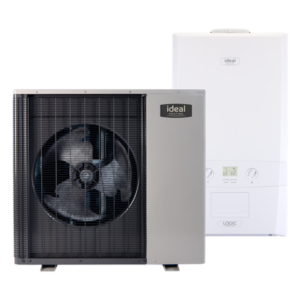
A hybrid heat pump system integrates an external low-temperature air-source heat pump (ASHP) alongside an existing or new high-temperature gas condensing boiler, managed by an intelligent electronic hybrid controller. By linking both heat generators into a single wet central heating distribution network, the system dynamically routes space heating and domestic hot water (DHW) generation between the electric heat pump and fossil fuel boiler depending on real-time operating efficiency, outdoor ambient temperatures, and energy cost inputs.
- Bivalent Threshold Operation: The electric heat pump, utilising standard air-source heat pump (ASHP) technology, carries the primary space heating load whenever ambient air temperatures remain above the design bivalent point (typically tuned between +3°C and +7°C in real-world UK retrofit applications).
- Peak Demand & DHW Auxiliary: When outdoor temperatures drop below the bivalent threshold or when high-temperature domestic hot water delivery is required, the gas boiler activates to deliver high flow temperatures or supplement heat output.
- Automated Controller Logic: System controllers (such as the Daikin MCK interface or Vaillant multiMATIC 720 / VR 71) evaluate efficiency on the fly using outdoor temperature sensors, flow temperatures, and input energy tariff rates to automatically switch between heat sources.
- Operational Priority Settings: System control logic allows the user to select specific priority modes, balancing parameters between lowest running cost, maximum carbon reduction, or rapid space heating recovery.
- Hydronic System Coupling: Both heat generators, whether integrated options like the Daikin Altherma Hybrid or split setups using a Vaillant aroTHERM plus alongside a gas boiler, share the wet heating circuit via a low-loss header or buffer vessel to ensure correct primary loop flow rates.
Hybrid Heat Pump vs. Gas Boiler vs. Full Heat Pump – Comparison Table
| Criteria | Hybrid System | Gas Boiler (Condensing) | Full ASHP |
|---|---|---|---|
| Upfront Installed Cost | £8,000–£14,000 | £2,000–£3,500 | £9,000–£16,000 |
| Annual Running Cost (3-bed semi, 12,000 kWh demand) | ~£1,050 | ~£1,420 | ~£1,180 |
| CO₂ Output (tonnes/yr) | 2.1t | 3.4t | 1.6t |
| Installation Complexity | Moderate–High (Hydronic coupling, dual supply) | Low (Direct drop-in replacement) | High (Emitter upgrades, buffer vessel) |
| Annual Maintenance Cost | £280–£420 (Combined HP + boiler service) | £80–£120 | £200–£300 |
| System Lifespan | 15–20 yrs (HP) / 12–15 yrs (Boiler) | 12–15 yrs | 15–20 yrs |
| Boiler Upgrade Scheme Eligibility | Not eligible (unless HP is standalone MCS-registered) | Not eligible | £7,500 grant available |
Selecting the optimal heating architecture depends strictly on property fabric, heat loss profile, and available capital budget. Standalone condensing gas boilers retain the lowest upfront installed cost, making them the default short-term economic choice, though they expose householders to long-term fossil fuel price volatility and maximum carbon emissions. Full ASHP installations represent the cleanest, most efficient solution for well-insulated properties (typically EPC rating B or higher) where low flow temperatures maintain design comfort levels, backed by £7,500 funding under current Boiler Upgrade Scheme eligibility rules. Conversely, hybrid heat pumps provide a pragmatic bridging solution for pre-1960s solid-wall housing stock. In these hard-to-treat properties, high peak heat loss prevents a standalone heat pump from economically meeting design flow temperatures during sub-zero conditions without extensive radiator and pipework replacement.
The Real-World Bivalent Point Problem in UK Housing
Manufacturer bivalent points of −2°C are lab fiction for most British homes. While idealised bench tests assume modern building fabric and low flow temperatures, real-world retrofit conditions force heat pump efficiency to drop sharply much sooner. High thermal losses in aged housing stock drive up required radiator flow temperatures, shifting the effective economic and operational bivalent switchover point significantly higher than datasheet projections.
- Technical Bivalent Definition: The bivalent point defines the specific outdoor ambient temperature where a heat pump’s maximum thermal output exactly equals the building’s heat loss rate, below which a secondary heat source must fire to bridge the capacity gap.
- Manufacturer Specs vs. Retrofit Reality: Technical spec sheets frequently publish bivalent operating points between −2°C and +2°C, relying on low design flow temperatures (35°C to 45°C) and low room heat loss values that assume modern wall and loft insulation.
- Impact of Aged Building Fabric: Approximately 37% of UK housing stock was constructed pre-1944, characterised by uninsulated solid walls with U-values around 2.1 W/m²K. These high heat-loss rates force existing radiators to demand flow temperatures of 60°C or higher, shifting the true bivalent point up to +3°C to +7°C (typically settling around +5°C).
- Quantified Winter Fuel Reliance: In a standard UK winter season (November through March, with mean ambient outdoor temperatures averaging 4.2°C), an elevated +5°C bivalent point results in the gas boiler firing for 60–70% of total heating run hours, vastly exceeding the ~20% boiler runtime quoted in generic marketing literature.
- Controller Optimisation Mechanics: System controllers such as the Daikin MCK interface or Vaillant multiMATIC 720 permit toggling between running-cost priority and carbon-reduction priority modes, altering the seasonal gas/electric fuel split by 15–20% based on live energy prices.
- Empirical Survey Requirement: Calculating a reliable bivalent threshold requires a comprehensive room-by-room heat loss survey in full accordance with MCS 022 standards; without this technical data, any operational bivalent point is merely an unverified estimate.
We’d argue any hybrid quote without a full MCS 022 survey is incomplete.
Hard Water, Plate Heat Exchangers, and the Hidden Maintenance Cost
Limescale accumulation in hard water regions exceeding 200 mg/L CaCO₃ degrades heat pump plate heat exchanger coefficient of performance (COP) by 8–15% within three years of continuous operation. Thermal transfer efficiency drops rapidly as calcium carbonate scales narrow exchanger channels, restricting primary fluid flow and forcing higher compressor discharge pressures.
- Geographic Hard Water Belt: Properties across London, Kent, Essex, Suffolk, Norfolk, Cambridgeshire, Bedfordshire, Hertfordshire, and parts of Hampshire and Surrey fall within severe hard water zones, where Thames Water routinely records 200–300 mg/L CaCO₃.
- Invisible Performance Loss: A hybrid layout’s secondary boiler automatically masks heat exchanger fouling; by firing sooner to bridge the thermal deficit, it maintains room temperatures while silently driving up gas consumption unnoticed on energy bills.
- Mandatory Protection Hardening: Clean operation requires installing a high-efficiency magnetic system filter (such as the Fernox TF1 or SpiroTrap MB22) alongside an electrolytic or magnetic scale reducer directly on the heat pump circuit.
- Routine Servicing Checks: Technical maintenance requires an exchanger pressure-drop check as part of the regular annual heat pump service checklist (£200–£300 annual cost) to clear early mineral scaling.
If your installer doesn’t mention water treatment on a hybrid quote south of the Humber, walk away.
5-Year Total Cost of Ownership – The Numbers Nobody Shows You
5-Year Total Cost of Ownership (3-Bed Semi, 12,000 kWh)
| Year | Hybrid (£) | Gas Boiler (£) | Full ASHP (£) |
|---|---|---|---|
| Year 0 (Installation) | £11,000 | £2,800 | £12,500 |
| Year 1 (Energy + Servicing) | £1,300 | £1,510 | £1,430 |
| Year 2 (Energy + Servicing) | £1,300 | £1,510 | £1,430 |
| Year 3 (Energy + Servicing) | £1,300 | £1,510 | £1,430 |
| Year 4 (Energy + Service + Fan Motor Replacement) | £1,480 | £1,510 | £1,610 |
| Year 5 (Energy + Servicing) | £1,300 | £1,510 | £1,430 |
| 5-Year Total | £17,680 (~£17,500 baseline) | ~£10,350 | ~£19,650 |
Evaluating a heating architecture strictly on upfront capital expenditure overlooks the long-term operational costs. While a hybrid system achieves a genuine 38% reduction in CO₂ emissions compared to a standard gas unit, the financial payback versus a straight gas boiler swap extends beyond 12 years under current price caps. Hybrids only maintain a TCO advantage over a full air-source heat pump if gas unit rates remain below 8p/kWh; any shift in the spark gap or adoption of smart time-of-use tariffs tilts lifetime savings toward full electrification. Detailed modelling on this financial split can be found in our comprehensive UK heat pump running costs breakdown. Please note that iHeatPump.co.uk presents these modelling figures as independent benchmark estimates rather than formal contractor quotes.
When a Hybrid System Is the Wrong Choice
A hybrid is not a universal answer. In several common UK scenarios it is the wrong investment. Installing dual-fuel heating infrastructure adds installation friction, ongoing maintenance overhead, and control complexity that yields zero financial or thermal benefit if your property fabric or energy supply profile cannot leverage both heat sources effectively.
- Off-gas-grid properties: Lacking a mains gas connection forces the boiler element to run on LPG or heating oil. High delivered-fuel unit prices destroy the operational economy, making a standalone ASHP or GSHP superior.
- EPC B or above (post-2010 builds): High fabric insulation levels mean a compact 5kW heat pump easily satisfies 100% of heat demand year-round, as confirmed by a home suitability assessment; an auxiliary gas boiler is redundant dead weight.
- Capital budgets under £6,000: Realistic hybrid installations start at £8,000. If capital is constrained, fitting a direct condensing boiler replacement at £2,800 is the honest choice over underfunding a complex hybrid rig.
- Flats or listed buildings lacking external space: Absence of permitted development rights or physical ground/wall clearance prevents siting the outdoor heat pump unit, rendering a hybrid unfeasible.
- Properties scheduled for EPC-A retrofits within 3 years: Deep fabric upgrades will drastically reduce peak heat loss, turning an installed gas boiler into a stranded asset before its operational lifespan ends.
iHeatPump.co.uk’s editorial position: buy the system your house needs in 2030, not the one that’s easiest to quote today.
Regulations, Compliance, and the Installer Vetting Checklist
A hybrid installation straddles three regulatory regimes simultaneously, and most installers are only certified in one. Integrating a gas condensing boiler alongside an air-source heat pump demands cross-disciplinary technical compliance spanning gas safety law, microgeneration design standards, and fluorinated gas handling. Contracting an installer who lacks verified certification across all three distinct domains exposes property owners to invalid manufacturer warranties, uncertified building works, and legal non-compliance.
- Gas Safe Registration: You must verify that the installation business and individual site engineer hold active Gas Safe registration (a 6-digit registration number, checked at gassaferegister.co.uk) specifically certified for domestic gas boiler work. Learn how to verify a Gas Safe registered engineer before accepting any contractor quotation.
- MCS Certification to MIS 3005: Confirm installer certification under MCS standard MIS 3005 for the air-source heat pump element. Without an MCS certificate issued at handover, no Boiler Upgrade Scheme claim is possible even if you convert to a standalone heat pump in the future.
- F-Gas Category 1 Qualification: Any technician fitting, brazing, or servicing split refrigerant circuits containing R32 or R410A compounds is legally required to hold a Category 1 F-Gas certification.
- Building Regulations Part L Compliance: The completed installation requires mandatory Part L sign-off, certified either through an accredited competent-person scheme (such as APHC, CIPHE, or NAPIT) or direct local authority building control notification.
- Site-Specific Bivalent Calculation: You must demand written confirmation of the bivalent point calculation derived directly from your property’s detailed heat loss survey, not an arbitrary manufacturer spec sheet.
- Commissioning & Control Access: Confirm that the hybrid controller is fully commissioned at handover and that the homeowner is granted full operational access to mode-switching parameters for cost versus carbon priority.
If any of these six items is missing from the quote, the installation is non-compliant or financially exposed.
The 2035 Question – Is a Hybrid a Bridge or a Stranded Asset?
The UK’s hybrid heat pump market is being sold on a 10-year window that may close faster than the industry admits. Promoted as a pragmatic stepping stone for hesitant consumers, dual-fuel heating architectures face mounting policy pressure, shifting grid economics, and long-term regulatory obsolescence. As domestic decarbonisation mandates tighten and grid electricity decarbonises, installing a gas-reliant appliance risks locking property owners into unnecessary supply infrastructure fees and eventual premature equipment replacement.
- Future Homes Standard Pressures: The implementation of the Future Homes Standard effectively excludes gas boilers from new-build residential housing. This structural market pivot eliminates the high-volume manufacturing subsidies and supply-chain economies of scale that historically kept domestic gas boiler components inexpensive.
- Decarbonising Electricity Grid: National Grid ESO projects average UK electrical grid carbon intensity falling below 100g CO₂/kWh by 2035. As offshore wind and renewables dominate generation, the carbon reduction argument for firing a fossil-fuel boiler element during peak cold snaps completely erodes.
- Gas Standing Charge Penalty: Ofgem’s fixed standing charge tariff structure imposes a mandatory baseline cost exceeding £115 per year simply to keep an active gas meter connected, creating an ongoing financial penalty for households using gas solely as a secondary backup.
- European Regulatory Alignment: The EU’s 2024 Energy Performance of Buildings Directive (EPBD) revision signals a complete 2040 phase-out of fossil-fuel boilers, establishing an international regulatory benchmark that UK heat pump policy and the 2035 timeline will ultimately mirror to maintain statutory net-zero commitments.
iHeatPump.co.uk’s view: a hybrid installed in 2025 is rational for a solid-wall 1930s semi. The same system installed in a 2015-build new estate is a 10-year stranded asset. Context is everything.
FAQ
No. The Boiler Upgrade Scheme pays £7,500 only for standalone air-source or ground-source heat pumps that are MCS-certified under MIS 3005. A hybrid system that pairs an ASHP with a gas boiler does not qualify unless the heat pump element is installed and registered as a standalone, independently controlled system. Most hybrid quotes from UK installers do not meet this criterion.
Manufacturer data sheets typically state a bivalent point of −2°C to +2°C. In practice, UK solid-wall properties built before 1960 with U-values around 2.1 W/m²K shift the effective bivalent point to between +3°C and +7°C. This means the gas boiler fires for 60–70% of heating hours between November and March, significantly higher than marketing literature suggests. A room-by-room heat loss survey to MCS 022 is essential to calculate the true figure for your property.
In hard water regions (200–300 mg/L CaCO₃, covering London, Kent, Essex, Suffolk, Norfolk, and parts of Hampshire), limescale accumulation on the heat pump’s plate heat exchanger reduces COP by 8–15% within three to four years. Because the hybrid’s gas boiler compensates for the lost output, the efficiency drop is often invisible on energy bills. A magnetic system filter such as a Fernox TF1 or SpiroTrap MB22 plus an annual descaling check at the heat pump service is mandatory in these areas.
A compliant hybrid installation requires three separate certifications: Gas Safe registration (verified via a 6-digit number at gassaferegister.co.uk) for the boiler element, MCS certification to MIS 3005 for the air-source heat pump element, and F-Gas Category 1 certification for any work on R32 or R410A refrigerant circuits. Additionally, the installation must satisfy Building Regulations Part L via a competent-person scheme or local authority sign-off. An installer holding only one of these credentials cannot legally or compliantly complete a full hybrid installation.
Financially, a hybrid system costs £8,000–£14,000 installed versus £2,000–£3,500 for a condensing boiler. Annual running costs are roughly £250–£350 lower for the hybrid on a 12,000 kWh property, giving a payback period of 12–18 years on the capital difference. The case strengthens in pre-1944 solid-wall homes where a full ASHP cannot meet peak demand, and weakens in EPC B+ properties where a standalone ASHP outperforms the hybrid. The carbon reduction versus gas is approximately 38%, which is meaningful but not equivalent to full electrification.
