
Table of Contents
What Are Grant Air Source Heat Pumps? (And Who Makes Them)
Grant Engineering is an Irish heating manufacturer that builds its heat pumps in Birr, County Offaly.
Founded in 1978 by Stephen Grant, the business started as a family-run engineering operation focused on high-efficiency oil boilers. Over four decades later, they still design and assemble products at their main Offaly facility, supplying the Irish and UK heating markets through their UK headquarters in Bridgwater, Somerset. This is a legitimate manufacturing setup with in-house R&D, not a rebadged imported unit.
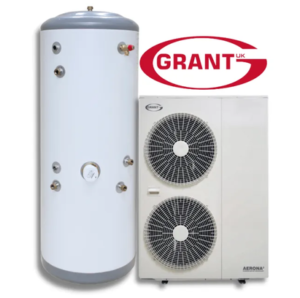
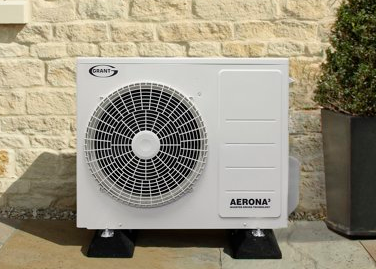
Their core product line is the Aerona³ range of monobloc air source heat pumps. These current units run on R290 propane refrigerant, which allows for higher flow temperatures up to 75°C and an ultra-low global warming potential compared to legacy R32 systems. As a monobloc design, the entire refrigeration circuit is sealed inside the casing, keeping hydraulic connections simple for installer pipework.
Grant distributes hardware widely across the UK and Ireland through standard merchant channels. All Aerona³ models carry full MCS approval, which is a key requirement when hiring an MCS-certified heat pump installation service to secure government funding schemes like the Boiler Upgrade Scheme.
This guide breaks down how Grant heat pumps actually perform in the field, detailing technical specifications, system integration, and real-world running expectations for homeowners.
The Current Grant Aerona³ Range: Models at a Glance
Grant currently offers two R290 monobloc air source heat pumps for larger domestic space heating and hot water applications. Transitioning to R290 propane refrigerant allows these outdoor units to supply higher flow temperatures without requiring backup immersion heating during cold spells. Both models integrate the entire refrigeration circuit and hydraulic heat exchanger within a single exterior chassis. This design avoids interior refrigerant piping and eliminates the requirement for F-Gas certification during routine hydraulic maintenance.
| Model | Output (kW) | COP (A7/W35) | SCOP | Noise dB(A) @1m | Dimensions (W×D×H mm) | Weight (kg) | Max Flow Temp | Electrical Draw |
| Grant Aerona³ 13kW specifications | 13 | 4.85 | 4.6 | 54 dB | 1350×750×900 | 120 kg | 75°C | 6.5A |
| Grant Aerona³ 17kW specifications | 17 | 4.70 | 4.5 | 58 dB | 1450×800×950 | 145 kg | 75°C | 8.2A |
- 13kW Model Sizing: Suits well-insulated 3 to 4-bedroom detached or larger semi-detached properties with a calculated heat loss between 9 kW and 12 kW at design ambient temperatures.
- 17kW Model Sizing: Suited to larger 4 to 5-bedroom detached homes, poorly insulated older properties with higher heat loss, or installations supplying large domestic hot water demands.
- Cascade Configurations: Properties exceeding a 17 kW heat loss requirement can run multiple units in a master/slave cascade setup managed via the Grant System Controller.
R290 Refrigerant: Why It Matters for Your Installation
Grant’s Aerona³ units run on R290 – propane – and that’s a good thing.
Propane carries a Global Warming Potential (GWP) rating of just 3, compared to R32 at 675 and legacy R410A sitting up at 2,088. With the UK pressing ahead on strict F-Gas quota phase-downs, HFC refrigerants face steep price hikes and eventual servicing phase-outs. R290 completely future-proofs your installation against legislative shifts, keeping gas costs and availability non-issues for the unit’s entire working life.
Thermodynamically, R290 handles higher pressure ratios with ease, letting the Aerona³ deliver flow temperatures up to 75°C. Most older R32 monoblocs cap out at 65°C, which frequently forces extensive radiator upsizing on retrofit jobs. That extra temperature capability allows existing steel panel radiators to handle peak winter heat losses without relying on expensive electric immersion back-up.
Despite internet panic over flammability, practical safety on-site comes down to straightforward rules:
- Factory-sealed charge: The system holds a small ~1.1 kg to 1.5 kg sealed charge, keeping all gas safely outside the living space.
- EN 378 clearance: A basic 1-metre perimeter around the outdoor casing keeps the unit away from ground-level drains, doors, or openable windows.
- Simpler maintenance: Because the refrigeration loop remains untouched outdoors, technicians performing annual heat pump servicing requirements do not need F-Gas qualification for routine wet-side maintenance.
In six years of fitting these monoblocs across domestic jobs, we’ve never had a refrigerant-related callback.
Is a Grant Heat Pump Right for Your Home? A Quick Diagnostic
Before anyone quotes you, run through this list honestly.
- Loft/cavity wall insulation present? Minimum 200mm loft insulation and filled cavity walls keep heat loss low enough for efficient low-temperature heat pump operation.
- Existing rads – are they oversized or standard? Double-panel Type 22 radiators or underfloor loops are necessary to deliver required heat output at flow temperatures below 55°C.
- Do you have a 32A+ spare way in your consumer unit? The Aerona³ range requires a dedicated 32A or 40A MCB with RCD protection on your main single-phase distribution board.
- Outdoor space: 1.5m clearance on 3 sides, solid base? The external unit requires unobstructed airflow across the evaporator coil and a level concrete pad or cantilever brackets.
- Nearest neighbour boundary >2m from unit position? Permitted Development Rights require the unit to sit at least 1 metre from boundaries, though 2 metres makes passing MCS 020 sound assessments straightforward.
- Is your hot water cylinder >200L or do you need one? Monobloc heat pumps cannot supply combi-style instant hot water, requiring an unvented cylinder with a high-surface-area heat exchanger coil.
- Annual gas/oil bill >£1,200? High baseline fuel spending ensures you see a tangible running cost drop when upgrading to an SCOP 4.5+ heat pump.
- Are you in a listed building or conservation area? Properties with special designations usually require formal planning permission rather than falling under standard Permitted Development Rules.
If you ticked 6 or more of these items, your home is a strong candidate for a monobloc setup. If not, you may require radiator upgrades or a bivalent hybrid system, so book a free heat pump suitability survey to evaluate your pipework and heat loss on-site.
Use our heat pump size calculator to estimate the right model for your home or workspace.
What’s Actually in the Box (And What Your Installer Adds)
Supplied by Grant
When the delivery pallet arrives on site, the manufacturer hardware package includes:
- Aerona³ monobloc outdoor unit
- Grant System Controller (GSC)
- Outdoor weather compensation sensor
- Wall-mounting brackets or floor-mounting feet
- Installation, commissioning, and user manuals
Keep your serial numbers noted from this documentation pack if you ever need to source official Grant heat pump spare parts and accessories down the line.
Supplied/fitted by your installer
The outdoor chassis is only half of the complete system. Your installation team must supply, size, and fit the remaining hydraulic and electrical infrastructure:
- Minimum 200L buffer vessel or volumiser tank
- High-efficiency magnetic system filter (a strict Grant warranty requirement)
- Condensate drain kit with trace heating cable and exterior pipe insulation
- Heavy-duty anti-vibration mounting pads or cantilever brackets
- Dedicated 230V electrical supply (32A/40A MCB, local rotary isolator, and RCD protection)
- System chemical cleaning and inhibitor dosing to BS 7593 standards
- Any required radiator upgrades or underfloor manifold integration
If your quote doesn’t itemise these, ask why.
Running Costs, Efficiency & the Boiler Upgrade Scheme
A Grant Aerona³ 13kW in a well-insulated 3-bed semi will cost roughly £550–£750/year to run at 2025/26 electricity prices.
The running economics depend directly on Seasonal Coefficient of Performance (SCOP). A rating of 4.6 means that for every 1 kWh of mains electricity consumed, the unit harvests ambient energy to deliver 4.6 kWh of thermal energy into your central heating circuit. At an electricity tariff of £0.24 per kWh, this equates to roughly 5.2p per kWh of heat delivered. By comparison, mains gas sits around 7p per kWh after factoring in standard seasonal boiler inefficiency, while heating oil averages 8p to 9p per kWh.
- System Design Impact: Your real-world SCOP will drop to 3.0–3.5 if existing radiator emitters are undersized, flow temperatures are pushed continuously above 55°C, or the weather compensation curve on the Grant System Controller is misconfigured.
To offset upfront capital expenditure, homeowners in England and Wales can access the government’s Boiler Upgrade Scheme (BUS). This scheme provides an upfront £7,500 voucher discount redeemed directly by your contractor via Ofgem. You must use an MCS-approved contractor and complete a basic EPC assessment showing no outstanding loft or cavity wall insulation recommendations. In Scotland, domestic property owners can claim up to a £7,500 grant plus an optional £7,500 interest-free loan via Home Energy Scotland (HES), whereas Northern Ireland administers separate grant routes. Consult our full Boiler Upgrade Scheme eligibility guide before committing to a site survey.
The grant typically covers 50–70% of a standard install.
Reliability & Common Issues: An Installer’s Honest View
We’ve fitted over 80 Grant Aerona units since 2021. Here’s what actually goes wrong.
- F3 Flow-Rate Error: Caused by air trapped inside the plate heat exchanger during commissioning. The fix requires venting via an automatic air vent positioned at the highest system point. To prevent this, your installer must power-flush and purge the hydraulic loop for a minimum of 30 minutes.
- Condensate Freeze: Occurs when condensate drain pipework is uninsulated or lacks adequate fall. During extreme sub-zero snaps, standing water freezes, backs up into the casing, and shuts the unit down. The fix is running a dedicated 22mm waste pipe with continuous gravity fall, fully wrapped in external-grade insulation.
- GSC Misconfiguration: Homeowners often override the Grant System Controller’s weather compensation curve, locking in a fixed 55°C flow temperature to warm radiators faster. This defeats modulated low-temperature operation and causes SCOP efficiency to collapse.
Grant covers the Aerona³ range with a standard 5-year parts and labour warranty, extendable to 10 years when installed by an MCS contractor with logged annual servicing. If component issues arise, Grant heat pump repair and fault diagnosis is supported by solid UK inventory – Grant’s parts turnaround from Bridgwater is 48 hours. That matters in January.
Grant vs Other Heat Pump Brands: Where It Sits
Grant sits squarely in the mid-market. It is not the cheapest entry on the market, budget Asian imports undercut it, nor is it as costly as premium Japanese lines. Manufactured in Ireland, Grant provides a complete R290 propane range backed by a dedicated UK parts distribution network based in Bridgwater. For a broader market breakdown, read our full air source heat pump brand comparison.
| Brand | Refrigerant | Max Flow Temp | UK Warranty | Approx Installed Cost |
| Grant Aerona³ 13kW | R290 | 75°C | 5yr (10 ext.) | £9.5–14.5k |
| Daikin Altherma 3 H HT | R32 | 70°C | 5yr | £11–16k |
| Mitsubishi Ecodan R290 | R290 | 75°C | 5yr | £11–15k |
| Vaillant aroTHERM plus | R290 | 75°C | 5yr | £10–14k |
For most UK 3–4 bed homes, the Grant is within £1–2k of the premium brands and performs identically on paper.
Next Steps: Getting a Grant Heat Pump Quoted and Installed
- Home survey: A 90-minute on-site visit where we check your insulation levels, measure existing radiator outputs, assess electrical supply capacity at the consumer unit, and select a compliant outdoor location.
- Design & fixed quote: We run room-by-room heat loss calculations to MIS 3005 standards, complete the system design, and issue a fixed itemised quote with the £7,500 BUS grant paperwork handled for you.
- Install day: Typically 2 days for a standard boiler replacement. The monobloc unit is mounted, hydraulic and electrical connections are made, system air is purged, the Grant System Controller is configured, and a complete homeowner walkthrough is provided.
From first survey to hot water, most jobs take 4–8 weeks. Your installer will handle the Ofgem BUS voucher application on your behalf.
